Bible Memorization – Why Does it Matter?

I struggled with my self-image. I use the past tense purposefully, not because I never struggle with my self-image now, but because the days of despising myself are over. We have all been there! Even if the struggle is just the thought of “those extra few pounds make me look awful” or “I’ll just never be pretty enough” (you get the picture). Jesus is the one that changed this in me. It wasn’t an emotional kind of change, though. No, this change came from a single verse in the Bible by the grace of God.

We’ve all heard the verse, but try to hear me out and pretend you are hearing it for the first time. Proverbs 31:30 says “charm is deceptive and beauty is fleeting but a woman who fears the Lord is to be praised.” Although I believed my struggle was physical, this verse showed me that my problem was a lack of trust in the Lord. Take a second to dwell on that, friends: the culturally prettiest woman is not who we are called to praise, but the one that fears the Lord. The woman that submits in awe to the living God who created everything deserves praise.

PSALM 119

I memorized this verse and hold it in my heart and repeat it to myself whenever those thoughts creep in. This very first instance of depending on scripture opened my eyes to see the power it has in our lives and how I can give glory to the Father with my thought-life. I’m not the first person to have learned this and put it into practice, of course.

It’s an impressive and daunting task, memorizing scripture, and it’s hard to have enough discipline to practice, learn, and retain one verse, let alone a whole fleet of them! As hard as it may seem (and it’s truly not all that difficult), memorizing scripture is important to our private lives a well as our communities.

The importance of memorizing and knowing the Bible is that it is useful for teaching, reproof, correction, and training in righteousness (2 Timothy 3:16).Another reason to memorize scripture is that we are called to it! Colossians 3:16 commands us to “Let the word of Christ dwell in you richly…” The Bible is not meant to be something we think about only every so often, but something that we dwell on throughout our busy days filled with hardship and temptation.

When we memorize parts of the Bible, we bring them to the front of our minds. So when, for example, I am not honoring the Lord with my thoughts and dwell too much on myself rather than Him, it is useful for me to have Proverbs 31:30 memorized. I’m still working on my selfishness and other sin patterns, but this verse has changed who I am. The importance of Bible memorization is explained well in Psalm 119:11 when it states “I have stored up your word in my heart, that I might not sin against you.” Memorizing scripture is an effective tool for resisting the temptations of our sin nature.

Storing up truth from the Bible in our minds changes the way we live our lives because it changes how we think. No military general would ever send men into a battle ill-equipped so why do we do that to ourselves? The Lord gave us the whole of the Bible to use as armor and weapons (Ephesians 6:10-17) to fight against our natures- just like I use Proverbs 31:30 to this day. And our examples don’t stop there.

Jesus was perfect. He did not have sin nature like we do, but He still utilizes this tactic in His own life. We see Jesus memorized scripture and put it into practice in this same way even though He was without sin. We can read Luke 4 (go do it now!) and see a perfect example of how and why we should be memorizing scripture! Fighting against our sin nature is not the only reason to memorize truth, though. It’s also important because it feeds our souls.

It is said in Matthew 4:4 that “‘Man shall not live by bread alone, but by every word that comes from the mouth of God.’” We were made to live on the Word of God, not just on the things of this world. So when we allow God to change our personal lives to reflect Christ more clearly it creates a ripple effect into our fellowship with other believers.

Our actions matter. What we say and do effects not only ourselves but those around us. We need to serve our friends and loved ones as we are called (Philippians 2:4). One way to serve is to be wise and thoughtful in actions, deeds, and words using the truth found in the Bible. When we pour out not from ourselves, but from Christ and His Word, we serve others well.

Let’s serve others and strengthen ourselves to battle our sinful habits. Please don’t just read this and let it fade from your mind. I won’t let it fade from mine, either. I will continue to memorize and build up my arsenal so that I may be more like Christ. Next week we will be challenged on this topic. So dwell on the truth found in the Bible about such things. Pray that the Lord will enable you to push yourself to memorize and store up His Word in your minds. It has been a blessing in my life and I know it will be in yours as well.

What is the biggest excuse you use that gets in between you and the time it takes to memorize scripture? Pray about it, confess it to the Lord. What has to change in you for the challenge next week to be effective in your life?
Bible Study Resources

Choosing how to study the Bible can be a daunting task. Which one do we use? How do we know whether or not it’s trustworthy? Where do we begin? Well, those are fair and difficult questions that I can’t completely answer for you. But here are some resources to help you as you work to study the scripture.


We use the English Standard Version (ESV) for all our scripture references, unless otherwise noted. Bibles are translated in two ways: to convey word choice or to convey meaning. The ESV is a word-by-word translation. Here is a link to the ESV study bible. It’s helpful because it will have notes to help you understand.

The ESV Study Bible on Amazon


Personal Bible Study Helps

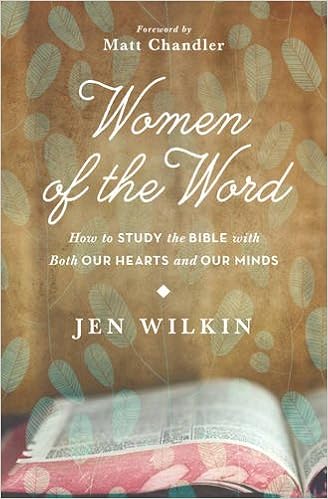
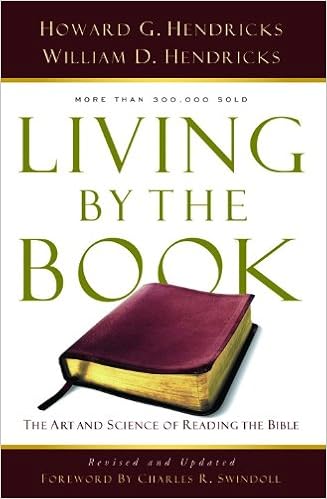
The two resources that helped me develop my every day study of the Bible are Women of the Word by Jen Wilkin and Living by the Book by Hendricks and Hendricks.


Living by the Book is a more complex and in-depth explanation of study. It’s a bigger book that helps lead it’s reader through in a studious way.

Living by the Book on Amazon


Women of the Word is easier to read. Her style is very conversational. She will lead you through how to study, step-by-step, and why it’s important.

Women of the Word on Amazon


Bible Studies

The following are Bible studies in that they are books that lead you through specific scriptures. It’s not a how-to on studying on your own, but studies of specific books of the Bible.


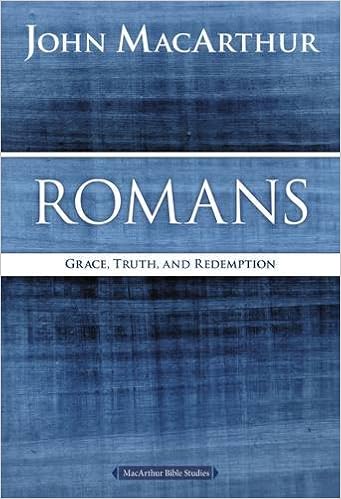
John MacArthur Bible Studies: 

This is a series of studies that include commentary and questions to help readers understand.

Bible studies on Amazon


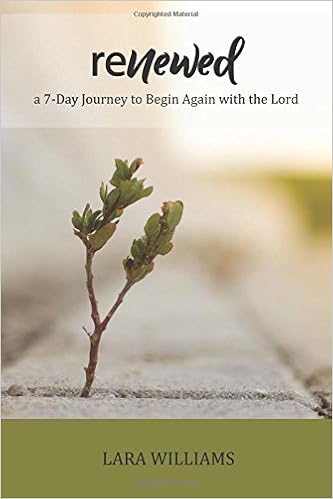
Lara Williams Studies:

Lara looks at her personal experiences through the lens of scripture. And uses that to help you learn how to study the Bible.

Bible Studies and Books by Lara Williams


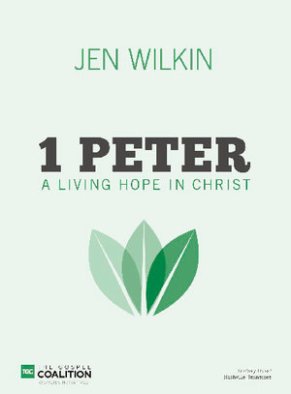
1 Peter - A Living Hope In Christ.jpg


Jen Wilkin Resources and Studies:

Here are Jen Wilkin Bible studies and books, including the one listed above.

Books and Bible studies by Jen Wilkin


Devotionals

These devotional resources are shorter, daily reads. They will help to focus your mind on the Lord while opening up some deep truths.


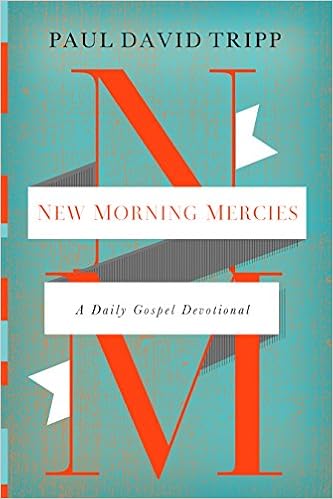
New Morning Mercies by Paul David Tripp

New Morning Mercies is a modern devotional. He is compelling and easy to read, but the truths that he unpacks are solid and will give you something to think about and meditate on throughout the day.

New Morning Mercies


Morning and Evening by Charles Spurgeon

Morning and Evening is a classic devotional. Because of the classic nature and how old this is, some of the language is difficult to read. However, if you’re willing to sit with it for a tiny bit of extra time some days, it is packed with deep truth.

Get Morning and Evening in your inbox


We’d love to talk to you about any of these resources or ones you’ve used in the past! Let us know what you think of this list and what we missed.

How to Study the Bible – An Introduction

I walked into the Christian bookstore and went to the section with the signs reading: “Devotionals.” Easy! Go there, grab a devotional on a book of the Bible, and leave.

Not so easy.

Looking around that section at all the different books about motherhood, womanhood, verses of the day, mostly edifying and helpful (while others unfortunately should not have been in the Christian bookstore) was confusing. As I stood there staring at the mix of books, I kept thinking that it had to be simpler than this. Why couldn’t I find a book to help me learn about the Bible?

A kind woman wearing a maroon vest turned the corner and asked if I needed anything. I told her that I was looking for a devotional to help me understand the Bible better. I explained that I wanted something to ask me questions and help me along the way as I read the Bible. She then explained that I was in the wrong section of the bookstore and lead me over to the wall of Bible studies.

The difference between a Bible study and a devotional is an important one. A devotional gives comments or encouragement on an idea or verse. There may be a handful of scripture references, but it’s mostly commentary to help you connect.

pray rr

A Bible study, on the other hand, helps you learn what the Bible says and what it means by what it says. It helps you know and understand it first, then connect and feel it second. While a good devotional is important, a full theology (your thoughts about God) cannot be established and rooted in truth without understanding the Bible in context including how the topics and ideas of the Bible flow throughout. A book on systematic theology can also help you put the categories and topics together in a coherent way, but that’s a topic for another day.

There’s not just one correct way to study the Bible. There are book options, but you can also study it yourself, at least to start.

This is a step-by-step of my preferred method – adapted from Jen Wilkin, Lara Williams, and Hendricks. Two things before you begin: research the context of the author and people to whom they are writing of whatever book of the Bible you are studying. Context is key to understanding what the writer meant by what he said. Second: Pray. Pray that the Lord would reveal Himself to you as you study His word, seeking to know Him more to love Him more.

Step One: Read the Bible.

This is the “what does it say” portion of studying. Read the Bible. That probably seems too simple. But that is the first step. Just read. Start with a book and stay there until you complete it. Read it all the way through. Multiple times. The shorter books, like Ephesians or Galatians, can be read through in a sitting. When I’m unable to read it multiple times, I listen to it. Reading through a book or multiple chapters helps you to keep it in context.

Repetition helps us see or hear things slightly differently. We’ll catch a phrase or word or detail that we’d missed the first few times. As I’m reading, I take note of words or phrases that repeat. Then lookup words that I don’t quite understand or that would make the meaning clearer with definition. This is a step that I learned reading Women of the Word, by Jen Wilkin. She looks up words, in English, and writes their definitions. Bible translators try to find the best words to communicate what was said in the original language, so we need to understand what the words mean in our own language.

Step Two: Summarize and explain

This is when I get into the “what does it mean” portion of breaking down a verse. I will rewrite it in my own words and look for verses that cross-reference and support. Sit with the scripture for a while. One urge I have is to look up a commentary as soon as I get stuck in a spot. Fight the urge! Instead, pray about it. Pray that the same Holy Spirit who inspired the writers of the scriptures and lives in you will help you understand them. Don’t worry when it’s confusing or you have to reread multiple times. Sit with it for a while before you look for help. At the same time, don’t think of commentary or sermons as a negative. They are terrific helps!

As you’re going through this step, I take note of any attributes of God that are in the passage. What is the passage telling you about God? That is- who the Bible is about. It’s not about you. It affects you and tells your story, but it’s not about you. This is also the time that I write any truths, promises, and commands.

Step Three: Application

This is the “what do I do now?” portion of the study. Take it personally. What did you learn about yourself? What sin do you need to confess? How can you glorify the Lord? There are many questions to consider, but these are a few.

Bible study is amazing because it is simple enough that you can get a grasp of the concepts. But it’s complex enough that you can study it your whole life and never run out of topics or depth.

On Thursday we’ll be sharing some of our favorite Bible study resources. The idea is to know God more by understanding His word more fully.

What are your biggest struggles or fears when trying to study the Bible for yourself?


Resource Engagement on the Inerrancy​ and Infallibility of the Bible

John MacArthur’s short video on the inspired word of God is a great and quick listen! It breaks down the “so-what” aspect of what we discussed a few days ago, the infallible and inerrant Bible breathed by God Himself. The video gives an eloquent and brief look at the importance of the questions of the Bible’s infallibility and authority. I enjoyed MacArthur’s explanation of the importance of never allowing ourselves to waiver on the issue of the Bible’s infallibility. It is far too important.

John MacArthur on Education – Infallible vs Inerrant:

https://www.youtube.com/watch?v=J1TWTq7QKiE

The next resource is a short article from Ligonier ministries titled “Inspiration, Infallibility, Inerrancy”. The article gives a quick overview of the three topics contained in the title, Inspiration, Infallibility, Inerrancy”. The article also points out excellently that to say the Bible has errors is to question the very character of God. They were both quick, but still filled with useful information.

Inspiration, Infallibility, Inerrancy:

https://www.ligonier.org/learn/devotionals/inspiration-infallibility-inerrancy/

The Gospel Coalition has many articles and videos to help us understand the Bible. This video features D.A. Carson, John Piper, and Tim Keller discussing Biblical authority. I like it because it’s a conversation that allows listeners to see why it’s important to dig into scriptures without compromise.

Biblical Authority in an Age of Uncertainty:

https://www.youtube.com/watch?v=hBbfb8Zbxn0

I hope you find these helpful and as intriguing as I did!

Happy learning!

The Bible: Our Foundation

It was my first appointment. My husband was sitting on the chair next to the wall and the doctor was getting ready to look at my uterus. Then the doctor said, “there is a pregnancy. And there is a pregnancy.”

Twins.

Two babies. At the same time. When we weren’t even planning on having one for some time. It was overwhelming and exciting and crazy! Now those twins are almost 3 years old. A girl and boy who love each other and fight over elephant vs. fish videos on YouTube. They are kind and loving and sweet. While simultaneously being my real-life example of the effects of original sin.

My son likes to climb on things. He climbs up on the sofa then tries to walk off. He’s not very tall. His little legs do not allow him to step down easily. He is not a bird and cannot fly. Yet, he attempts to do things that could hurt his little body. When standing (now is not the time to lecture me about allowing my children to stand on the sofa) on a foundation that is solid and holding him well, he often attempts to step into the air.

We do this with the Bible. The Word of God does not change. It is strong and firm and keeps us safe. It is our foundation. I once heard someone say that the problem with Christians is that they take the Bible “too seriously.” But my question for that person is, “what is too serious?”

the bible rr

If all the things the Bible says about itself are true – and they are – then what exactly is the reason we have to step off that foundation? We are kept on all sides by the truth of the scripture. When we compromise our foundation, we are like my son stepping off of the sofa with tiny legs not expecting to be broken by the crash landing. Only our crash will be much more painful and life-threatening. When we step off, we don’t break our legs, we sin against our perfect, Holy God by compromising the fact of His existence and Lordship.

Because there is no neutrality.

One game we play is that we can start in the middle, in neutral, and work our way to God. But that’s not how it works. We start with God. “In the beginning, God…” (Genesis 1:1). The first thing that happens in the Bible is the assumption of God. We can assume Him as our foundation. We do not prove Him as our foundation. We do not give up that foundation when speaking with someone who disagrees. We do not reason our way to God because without God there is no reasoning. When we feel ourselves wavering, we must return to the foundation. Let’s stand firmly on the unmovable God who created the whole world and has always existed.

This is not a matter of opinion. I like to share my opinions on many topics: politics, education, food, etc. But this foundation transcends opinion. When confronted with an idea, God uses His Word to remind us and teach us what is true. When our thoughts or ideas disagree with the foundation, we submit to the truth of scripture, because otherwise we believe the lie that we know better than God (Romans 9).

Jesus valued scripture. When He was tempted by the evil one, He quoted scripture as his defense (Luke 4). He didn’t discount the scriptures and give all the reasons for why He wouldn’t fall for temptations that were outside of the Father. He leaned into truth and trusted the Father. We want to have the same uncompromising approach to the Bible, not stepping off of our foundation.

Thursday we will share resources to help bring these thoughts together. The infallible, inerrant word of God needs to be the solid ground beneath our feet. We need to stand firmly on it, unwavering and uncompromising. When we make decisions, they stem from what we believe foundationally.

-JaQuinn

What does your foundation look like? Is it easily swayed by your emotions or do you work to ensure that you begin with God?  

The Bible: Inerrant and Infallible

I go to a liberal arts university. It’s not a “safe space” for me, but it’s a place to learn and share the gospel with people who are lost and hurting.  In my escapades around campus, I’ve had more than one conversation with students that struggle with the Bible’s authority, it’s timelessness, and it’s infallibility. These issues are worth diving into because it is true that the Bible is the word of God, breathed by Him, and incapable of being incorrect. Let’s start with the One who made everything.

God is perfect. He is infallible, meaning He is not able to make mistakes. If we take a look at the second half of Matthew 5:48 it states that  “your heavenly Father is perfect.” Another verse that talks of God’s perfection is Deuteronomy 32:4, “The Rock, His work is perfect, for all His ways are justice. A God of faithfulness and without iniquity just and upright is He.” The Bible reminds us time and time again that He is unfaltering in His flawlessness. This perfect God is what the Bible is based on. The truth is that scripture is breathed by God, the same God that cannot make mistakes.

lion rr

Scripture is God-breathed. In 2 Timothy 3:16 we see that “all scripture is breathed out by God and profitable for teaching, for reproof, for correction, and for training in righteousness.” This verse from 2 Timothy breaks down for its readers the source of his writings. It doesn’t say “some scripture”, but “all scripture”. It is breathed by God through His divine inspiration. God gave the words and thoughts that comprise the Bible to the men that wrote them down. They are not the thoughts and ideas of a flawed person, but the perfect work of God. This book was written down by man, and an important facet of our lives as Christians. So then, if this book is God-breathed, who gives it the power to correct and teach? God does, not man.

The Bible is authoritative. This authority goes against society’s expectations because it’s not given by man, but by God. In 2 Peter 1:20-21 it says that “knowing this first of all, that no prophecy of Scripture comes from someone’s own interpretation. For no prophecy was ever produced by the will of man, but men spoke from God as they were carried along by the Holy Spirit.” We see in scripture that the Bible needs no man’s claim for its authority. This book claims authority for itself through God. This foundation of knowing who gives the Bible the power to instruct mankind is pivotal in our understanding of its inerrancy and infallibility.

The Bible is never wrong. That is what we mean when we say it is inerrant, it is never wrong and will never be wrong. This is because God, our God, is an unchanging rock that stood, and continues to stand, the test of time— that is, eternity. He is the same God He was in the Old Testament, in the New Testament, and in the present day. Don’t just take it from me, though, in Psalm 102:27 the Bible clearly states the following about our God: “but you are the same, and your years have no end.” Plainly it is written that the Lord is eternal and unwavering in His consistency. Then again in Malachi 3:6, it states “For I, the Lord, do not change…” The Lord tells us Himself and through those He inspired to write the Bible that “[He] is the same yesterday and today and forever” (Hebrews 13:8).

The Bible is truth. It’s plain and simple. It is given authority by the God who has never changed. The Bible is written only by those that were doing the work of God. He breathed the words into existence, but, yes, He used men. This doesn’t hurt the authority or inerrancy of the Bible but gives more glory to Him who made it possible. These truths give us our foundation. We are uncompromising in our decisions when they are based on this truth because we submit to our Father. Our foundation is a rock beneath our feet, if we use it as it was intended.

Next week we will talk more about the Bible as our foundation and explore what that means for our lives. It will investigate the importance of unshakable dependence on our foundation of the Bible. We will talk about the dangers of neutrality. So I want to leave you with these questions:

Do you believe wholeheartedly that the Bible is the infallible word of God? How and in what way does knowing all this change the way you approach the Bible?

Welcome to Rooted and Redeemed

One of my friends had rocking chairs on her porch. She was noticeably older than me – I was just out of college and she had two kids in high school. I was unmarried, but dating. She had been married half of her life. Each time I went to her house, she would make me tea and we would sit on the porch to rock and talk about our lives.

In those rocking chairs, I asked her hard questions. I asked for advice and shared my struggles and sins. She held me accountable. She preached truth to me. She didn’t leave me where I was. She loved me well.

It was in those front porch moments that I began learning what living the gospel in every moment looks like. She didn’t work it into conversation, it was her life. That’s what I wanted. How could I know God so well that He was my life – instead of a part of it that I needed to “tap into”? Where should I begin? How do I know God?

The Bible.

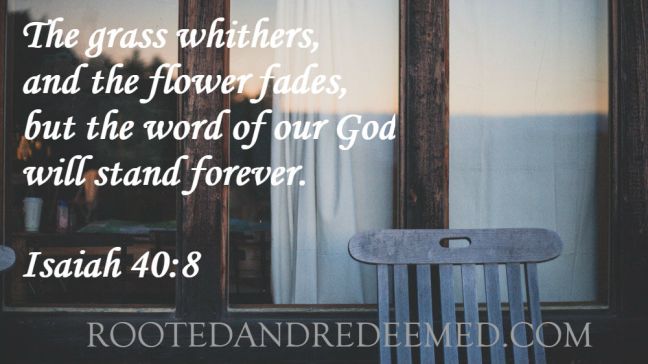
The Bible is where the Lord has chosen to reveal himself to us.

Isaiah 408

His word, what He was told us, is what lasts. It sustains. We can listen and meet Him in those words.

But so often instead of meeting Him there, in a complex, full space that requires a healthy dose of mental and intellectual engagement, we try to take the easy way out. We sit quietly in our spaces attempting to provoke strong feelings instead of engaging with hard, deep truth. We have believed the lie that if we know too much our faith will be shaken – as if it’s all dependent on us. We pick through the scriptures to make ourselves feel better – instead of using the scriptures to get to know God better.

That is why we’re here. Have you ever sat down to read a “hard” or “scary” passage of your bible and decided it was too much? Have you googled a verse to hit your feels just right instead of relying on the fullness of God and His attributes to sustain you? How often have you tried to listen to a sermon or podcast or read a blog or book and just couldn’t engage it? Did you feel inadequate or like that particular task or topic wasn’t for you? I’m here to tell you that is not true. We, as moms, daughters, students, career women, et cetera, can know God. We can know Him as we get to know our Bibles. We will be rooted in Him as we get to know His word.

“Blessed is the man who trusts in the Lord, whose trust is the Lord. He is like a tree planted by water, that sends out its roots by the stream, and does not fear when heat comes, for its leaves remain green and is not anxious in the year of drought, for it does not cease to bear fruit.” Jeremiah 17:7-8

RR TREE

This person – the one who trusts in the Lord – has deep roots. She is not moved by every feeling or uncertainty. She is not anxious and afraid because she knows who her Redeemer is! She’s not relying on how she feels about herself or her Redeemer, but her fruit continues no matter her circumstance or feelings!

Jeremiah 17:9 goes on to say, “the heart is deceitful above all things, and desperately sick; who can understand it?” We don’t follow our hearts because our hearts lead us readily astray. Instead, we put our trust in the Lord who saves! We seek Him with all our minds and he will renew us.

Rooted and Redeemed was started to help women get to know God. We want to not only feel strongly, but engage with the Word. We want to understand some basic theological terms and overcome the fear of learning too much or being too dumb. Because God has spoken to us. He has revealed Himself, so we should get to know Him.

I have two rocking chairs on my front porch now. If we were face-to-face, I would invite you over, make you a cup of tea, and talk about God. We would talk about a loving, kind, compassionate, just, holy God. Because we’d remember that it’s not about us. He roots us. He redeems us.

Join us as we get to know Him more, together.

It’s Never Been a Fairytale

IMG_5692 (1)

Avoidance is my expertise. When I was a teenager, I would make up excuses to get out of anything I just didn’t feel like doing that day. I would pretend that nothing got to me (and still do, sometimes). Vulnerability is still a weakness of mine because it opens me up to be rejected, scorned, and judged. To this day, I struggle with being open and honest about the things that are hurting me. Instead, I hide away from those that love and care for me.

My family was no exception. I was terrible to them because of how broken I was. When I was younger, we went to church for a while as a family, but the stories I heard there were just that to me: stories. The God that parted the Red Sea and the Christ that died to atone for the sins of those He loves were nice fairy tales, but not something to build a life on. These misconceptions did not, however, last long.

My come-to-Jesus moment was your run-of-the-mill “ah-ha” moment (not that that makes it any less exciting). I was sitting on a carpeted floor, my knee resting on some girl, a guy’s shoulder pressed up against mine, and someone’s knees jammed into my back. This is just how a Young Life summer camp club goes. As uncomfortable as I was in the moment, I still heard what our speaker was telling us and what my own Young Life leader had been showing me for months. There is a God.

_ Hope rr

What I finally heard in this uncomfortable position, hot and surrounded by hundreds of other high school kids was this: the God I had heard so much about in church and school is real and He made each of us in His image. As this speaker explained who Jesus was and why He mattered, these concepts became more than just stories to me. The God that made everything cared if I knew Him. I was captured.

   I spent the next few hours thinking about how to respond to what I had heard because my life had been a wreck and I was feeling hopeless, lost, and unloved. This was my fork-in-the-road moment. The Lord had changed my heart, though. He gave me understanding in this moment and offered a peace so real that saying no was impossible. So I sat with my leader and cried. She listened.

This simple act of a smart and God-fearing woman listening to my (seemingly) small problems was a game-changer for me. She was giving me a gift I thought no one would ever give to me. That act of hearing me out, no matter how seemingly small the issue was, showed me a small part of the character of God. So I prayed in silence and it was done.

Knowing the Lord has challenged my habit of avoiding in a way that I never would have experienced apart from Him. I never would have shared any of this with you before I knew the Lord. Even this level of intimacy would have made me bolt before I knew Christ. It is a small example of the Lord’s power over my life.

It wasn’t a quick-fix, knowing the Lord, and actually, it made my life harder in some ways, but we are never told that it wouldn’t be hard. In fact, we are told just the opposite. John 16:33 says “I have told you these things, so that in me you may have peace. In this world, you will have trouble. But take heart! I have overcome the world.” Jesus spells it out for us– things will be tough and life will never be pretty and perfect, but we are told to remember what He has done and is doing in the world. The difference is that with Christ we have hope.

We have hope because God sent His Son to die so that in Him we may become new. I had the chance to become a new creation in Christ and His death atoned for my sins. So even though we are promised that there will be trouble and heartbreak, He has made us new. I experience a joy now that I never would have believed possible when I was younger. No one would ever have been able to convince me that I was capable of feeling the joy that comes from the Lord. Through Jesus’ sacrifice, I find a peace that is indescribable. I praise Him for His work in my life. It isn’t about me and it never was, it is all about Him.

Soph

A Story of Redemption – JaQuinn

Hello! Welcome to Rooted and Redeemed. My name is JaQuinn and I am so excited to have you here with us. My friend Sophie and I started this blog because we love the Lord and His word; and we want you to love Him too!

If we were face-to-face I would ask you so many questions about yourself to get to know you. But since I can’t do that right now, I wanted to start by telling you a little about myself.

1506552355438

You know Noah? The one who built the ark? That probably seems really far back to begin an introduction, but don’t worry I’m not that old. I was just reading his story recently. Noah is one of those stories that – especially if you grew up in the church – we’ve heard so many times! We’ve heard the story of this man, Noah, who God called to build an ark and to bring two of each kind of animal onto the ark with him and his family. While they were all on the ark God flooded the earth for 40 days and 40 nights. Then God gave the earth a reset, if you will, starting with Noah and his family.

It was just and good, because God is just and good. Before the ark building begins, God calls Noah righteous (Genesis 6:9). Noah is faithful and obedient and diligent, which we know because he completes a huge task (Genesis 6:22). And even though it doesn’t say that all the people mocked him, they probably did. I know that I would have some serious questions for someone who said that God told him to build a giant boat!

Anyway, the flood happens and then the land is dry and Noah and his family are out of the ark. God puts a rainbow in the sky to symbolize the covenant he makes with Noah to not flood the whole earth again.

And then…

Noah gets drunk (Genesis 9:21). Those of us who read the story as adults know this part. He gets drunk. What I just realized  is that Noah also gets naked. His son sees him naked and tells his brothers. The brothers (Noah’s other two sons) manage to get Noah out of this situation without seeing him naked. When Noah wakes up and realizes that one of his sons saw him naked, he curses his grandson – the son of the son who saw him naked.

Noah made a sinful choice. He then blames someone else, curses them, and the Lord is gracious to Noah. How do we know that God was gracious to Noah? Because he is regarded as faithful in Hebrews 11 and his story is still being told today. He is immortalized in the scripture – in God’s word which will never pass away. The gracious and kind God that we meet in Matthew is the same gracious and kind God that we meet in Genesis with Noah.

This is the same gracious and kind God that I’ve met.

my story - JaQuinn

I grew up as a church kid. I would probably call myself more self-righteous than actually righteous at the time, but I did have a desire to do the right thing. I was, as much as I could put it together, obedient and kind and accepting of people. Of course, there was some nuance to that acceptance that I didn’t understand, like what love actually looked like in truth. I wasn’t allowed to ask hard question. It was more of a “Jesus loves you. Now be quiet and don’t ask questions” situation.

Then I grew up and the Lord let me be like Noah. He let me go and be drunk and naked. I wouldn’t say that I was drunk and naked in the ways that Noah was. I would say that I was drunk and naked in much worse ways than Noah was. I blamed other people, much like Noah did. I ran away – 1000 miles away. And 1000 miles away, the Lord was gracious, and merciful, and kind to me.

1000 miles away from home he opened my eyes. He changed my heart. He turned me back to Him in ways that I didn’t even know were possible. I had told my mom that I didn’t want to hear anything about religion, or Christianity, and yet the Lord was gracious and kind to me. He did not wait for me. He sought me and saved me. I did not save myself. It was not my goodness. It was not my self-righteous works. It was not my obedience. I didn’t have any of those things. I knew better. And yet he was kind and He saved me.

My story, like Noah’s, isn’t about me. It’s about God. It’s about a God who sent His Son to die on my behalf so that He may call me, like Noah, righteous. Holy. His.

And that is a tiny glimpse of the God that we hope to help you know better here at Rooted and Redeemed. It’s just a peek, a glance, of the Lord who we will know when we get into our bibles and love His word.

Jen Wilkin – who you will hear quoted a lot here because we love and appreciate her passion for helping women understand scripture – says, “you cannot love that which you do not know.”

So, welcome to Rooted and Redeemed, where we hope to help you know the Lord more.